Three dimensions of leadership in digitalizing education in China
By Ji Liu,Professor, Shaanxi Normal University;MillicentAziku, PhDcandidate, Shaanxi Normal University; Ziyu Zhou, PhDcandidate, Shaanxi Normal University
At the 2025 Global Smart Education Conference in Beijingearlier this year, the GEMReportlaunched a new regionaledition demonstratingEast Asia’sleadership indigitalization,from AI-powered driverless cars in Wuhan to intelligent, digitally-smart cities in Tokyo.Thereport showed that China is putting education digitalization at the centre of policy and reform, with artificialintelligence,big data platforms, and smart learningenvironments being incorporatedinto curriculum, pedagogy, assessment, and school management.Our research group at ShaanxiNormal University has been tracking and analysing theselatestdevelopments, and wepresentthree compelling takeaways fromChina’s successstoryleadingeducationdigitalization.

Digitalization policy is coordinated at the high level
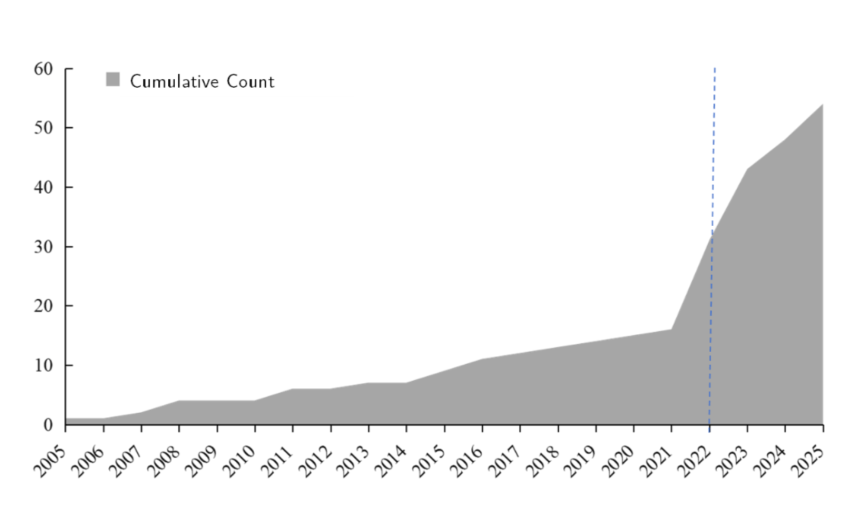
Over the past two decades, there has been a remarkable policy drive to provide robust support for teaching, learning, and research leveraging effective technology and tools. With the launch of the National Educational Digitalization Strategic Initiative in 2022, coordinated national policy actions have rapidly taken shape. These span smart teaching policies, teacher digital literacy standards, and a classification system of digital educational resources. In 2025, China launched the Master Plan on Building China into a Leading Country in Education (2024-2035), which identifies digitalization as a core initiative to jumpstart high-quality educational development and has been widely viewed as a new national strategic alignment for the coming decade.
National/Ministerial education digitalization policy documents, 2005-2025
Source:China Ministry of Education
A key product of these policy actions is the establishment of the world’s largest educational resource database,which promotes high-quality education access in rural and disadvantaged communities.Many teachers in rural communities benefit from these smart tools by integrating video animation into interactive instruction, fundamentally transforming conventional teacher-student relationships in the classroom.
There is emphasis in supporting academic and scholarly research
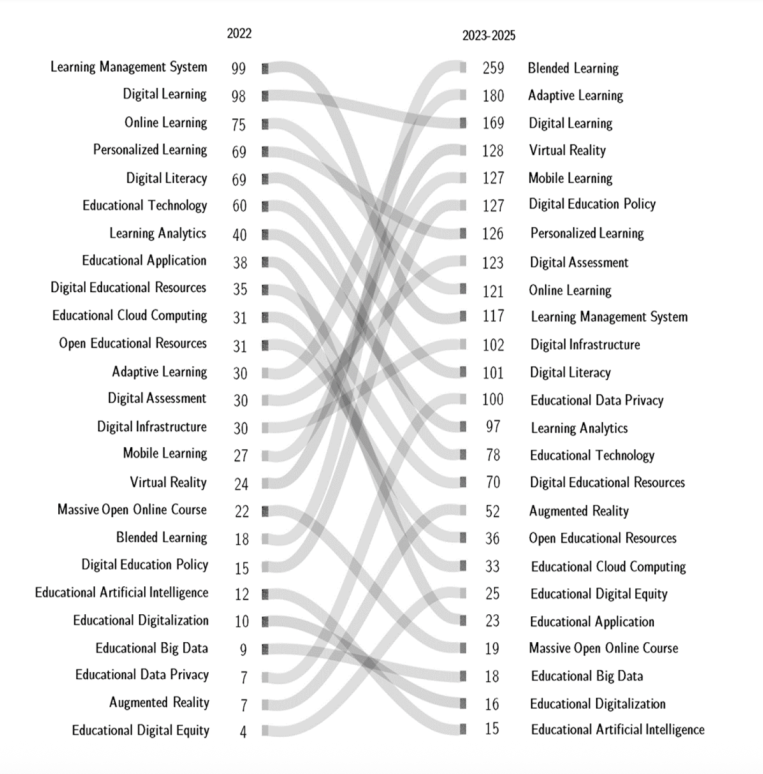
Since China’s opening up in 1978, China has continuingly put a strong emphasis on educational research. In recent years, national R&D investments in education are estimated to be growing at a pace of 10% each year. In 2025 alone, at least 50 national-level grants, worth more than USD1.5 million, were awarded to digitally relevant research projects by the National Office for Education Sciences Planning. As of September 2025, there were 3,151 scholarly publications indexed on the Web of Science database focusing on China’s education digitalization, covering an array of topics including digital infrastructure,digital leadership, and integration in STEM etc.
Global academic research on China’s education digitalization, 2022-2025
Source:Web of Science
This underscores China’s status as a leader not only in the applications of digital technology in education but also more broadly on its effects and implications for schools, teachers and learners. Increasing research funding has reinforced exploration into emerging topics in the area of AI, big-data analytics, and smart-classroom ecosystems, bringing in international collaborations on joint projects and in-depth comparative studies. Conclusively, the rise in research opportunities has positioned China as a global knowledge hub and living laboratory for large-scale digital initiatives in education.
Strategizing systematic integration in classrooms
More recently in China, a key focus widely discussed among policymakers, school administrators, and teachers, is the importance of classroom-level digital integration. The questions of how and to what extent AI-powered technology improves management, teaching, and learning have attracted increasing attention. On the one hand,many cities in China are actively incorporating AI-content in school-based curriculum. On the other hand, many schools are employing AI-powered tools to assist with after-school homework guidance by providing individualized step-by-step solutions and remedial help.
Similarly,Squirrel AI’s LAM is diagnosing students’ classroom performance and designing personalized learning paths. On university campuses across China,DeepSeek has been deployed to aid instructional processes, hence injecting new momentum into higher education. These emerging initiatives, among others, have attracted global media attention.
Looking ahead: What’s next?
As the global community sets out to revitalize short and medium-term growth prospects, it is essential to recognize that the digital technology revolution is here to stay, and that its immense societal impact will be long-lasting. Whether we like it or not, our next generation are indigenous to a digital world, meaning our schools must adapt to meet the new learning demands. Undoubtedly, there is an urgent need to adopt forward-thinking policy initiatives that can act effectively in light of swift changes in the labor market. Success stories such as that of East Asia as a whole, and of China in particular, should serve as motivation to advance digitalization on a larger scale and with greater resolve.
On the whole, governments and education ministries around the world should see how experiences from East Asia may be of value in facilitating new conversations and jumpstarting innovative ideas about realizing the immense value of a digital future for education. More critically, it will take strong leadership to answer calls for creating digitally-enabling environments, bridging new public-private partnerships, and testing new AI-powered tools that aim to transform the horizons of teaching and learning. The digital future is already here. What are we waiting for?
原文链接:Three dimensions of leadership in digitalizing education in China - World Education Blog